
Ecommerce Marketing Tips & Strategies
12 min read
Ecommerce Marketing Checklist for Small D2C Brands in India (2026)

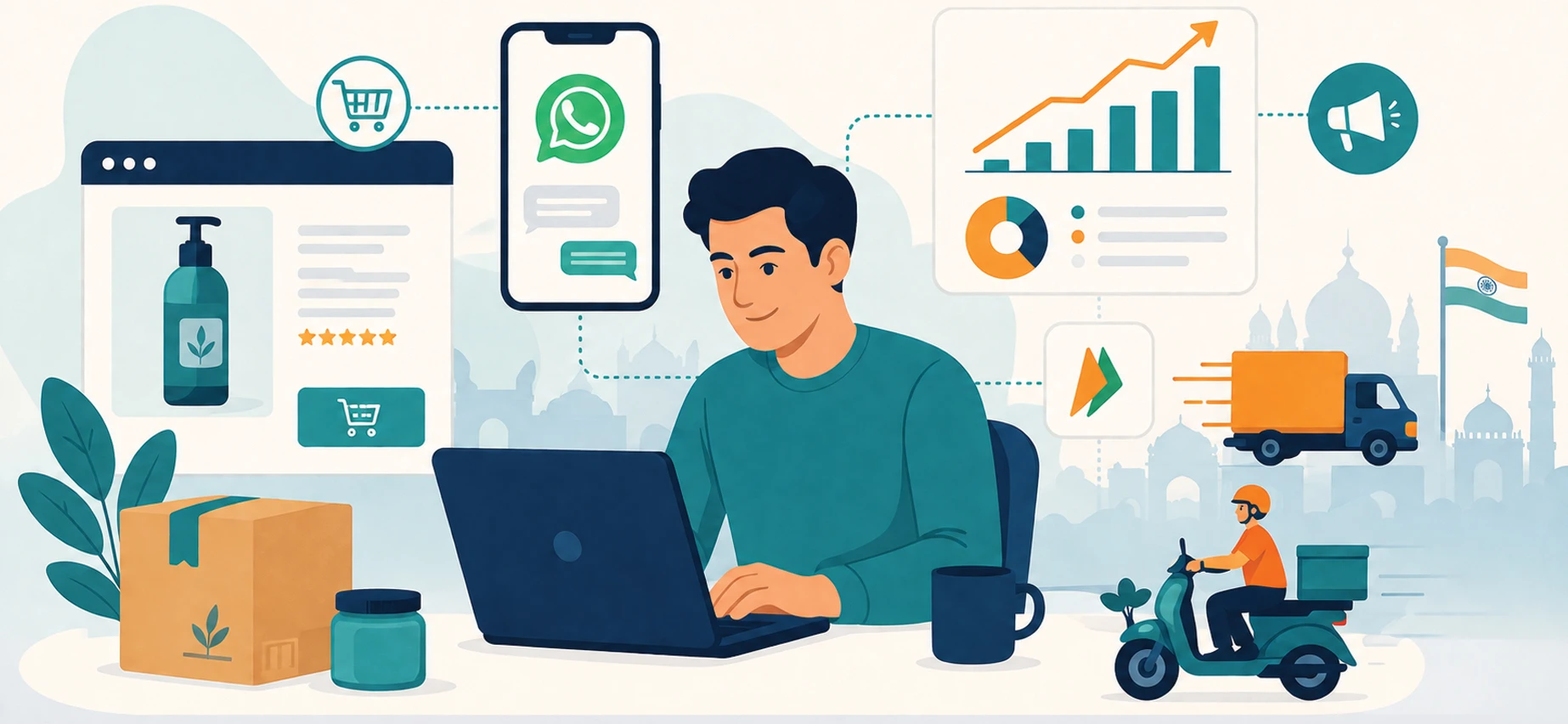
Search "D2C launch checklist" and you'll find dozens of guides covering GST registration, trademark filing, Shopify vs WooCommerce, and packaging suppliers. All useful — and all mostly about getting a store live, not about getting it customers.
This checklist assumes your store already exists, or is close to it, and focuses only on the marketing side: what to set up before you spend a rupee on ads, which channels actually deserve your limited budget, and which "trending" 2026 channels are worth testing versus skipping.
What This Checklist Covers (And What It Doesn't)
This is not a legal, logistics, or platform-selection checklist — if you need that, most website-builder blogs already cover GST, trademarks, and shipping partners in detail. This is purely the marketing layer: the things that determine whether the traffic you attract actually buys, and whether they come back. If your website itself isn't converting visitors yet, that's worth fixing before any of the checklist below, since no amount of ad spend fixes a broken storefront.
1. Marketing Foundations: Fix These Before You Spend on Ads
Every rupee spent on traffic is wasted if the storefront it lands on doesn't convert. Before turning on any paid channel, confirm:
- Your brand positioning fits in one sentence — what you sell, for whom, and why it's different from the next tab they'll open.
- Product pages have at least 5 photos per product, including one lifestyle or in-use shot, not just a plain white background.
- Product descriptions answer objections (fit, material, delivery time, genuineness) — not just list features.
- At least 5–10 real customer reviews are visible, even if you have to request them directly from early buyers.
- Trust signals are visible near the "Add to Cart" button: secure payment, return policy, and delivery estimate.
- A WhatsApp chat button is present on product and checkout pages — it meaningfully reduces last-minute hesitation for Indian shoppers.
- The site loads in under 3 seconds on a mid-range Android phone, since that's where most of your traffic will land.
- Google Analytics 4 and Meta Pixel (with Conversions API) are installed and firing correctly, tested with a dummy order, before any ad spend begins.
Skipping this step is the single most common reason small D2C brands feel like "ads aren't working" — when the real issue is a storefront that isn't ready to convert the traffic it receives.
2. Paid Acquisition Checklist: Meta, Google, and Marketplace Ads
Paid ads are usually the fastest way to get initial traction, but the checklist here matters more than the budget size.
Meta Ads Setup
- Business Manager and Meta Pixel installed, connected via Conversions API for accurate tracking post-iOS privacy changes.
- At least 3–5 creative variants ready at launch — a mix of static product shots, a short video or Reel, and one UGC-style piece.
- A retargeting audience set up from day one (site visitors, add-to-cart, past purchasers) even before you have enough data for lookalike audiences.
- Budget started small — ₹500 to ₹1,000 per day is enough to gather early signal without overcommitting.
Google Ads Setup
- Google Merchant Center feed connected and approved, since Shopping ads typically outperform plain text search ads for product-based businesses.
- Branded search campaign running (bidding on your own brand name) to capture people who saw you on Instagram and searched Google to verify you're legitimate.
- Category or problem-based search campaigns for terms your ideal customer would actually type, not just your brand name.
If you're unsure whether to prioritise Meta or Google first for a limited budget, the underlying logic is the same one covered in our Google Ads vs Meta Ads comparison — visually-driven, discovery-led products tend to do better starting on Meta, while products people already search for by name or category do better starting on Google. Our guide to running Meta Ads on a small budget goes deeper into creative and targeting specifics once you've picked a starting channel.
Marketplace Ads (If You Also Sell on Amazon/Flipkart)
- Sponsored Products campaigns running on your own top 3–5 SKUs, since marketplace ad auctions reward listings that already convert well organically.
- Marketplace listings kept visually consistent with your own website — mismatched branding across channels quietly erodes trust.
3. Organic & SEO Checklist for D2C Stores
Paid ads get expensive fast without an organic layer working underneath them. The checklist here is smaller but easy to neglect:
- Product and category pages have unique, keyword-relevant titles and descriptions — not the default text your platform auto-generates.
- A blog or guide section answers the questions your customers search before buying (sizing, ingredients, comparisons, "how to use").
- Product pages are written in a way that could be lifted and answered directly by an AI search tool like ChatGPT or Google's AI Overviews — clear specifications, plain-language benefits, and direct answers to common questions, since a growing share of product discovery in 2026 starts with an AI assistant rather than a traditional search results page.
- If you serve specific cities or regions, local SEO fundamentals are in place — see our local SEO checklist for the specifics.
None of this replaces paid acquisition, but it's what keeps your customer acquisition cost from climbing every quarter as ad platforms get more competitive. Our SEO service and content marketing service both feed into this layer directly.
4. Retention Checklist: Where Most Small D2C Brands Leave Money on the Table
Acquiring a first-time customer is the expensive part. Most small D2C brands spend heavily here and then do almost nothing to bring that customer back — which is where the real profit in D2C usually sits. At minimum, set up:
- Welcome sequence: 2–3 emails or WhatsApp messages introducing the brand and nudging the first purchase, sent automatically on signup.
- Abandoned cart flow: a reminder within a few hours of cart abandonment, ideally across both email and WhatsApp — this single flow alone typically recovers a meaningful share of otherwise-lost carts.
- Post-purchase sequence: order confirmation, shipping update, then a review request once delivery is confirmed.
- Reorder nudge: for consumable products, a reminder timed to when the product is likely running low (7–10 days after a typical usage cycle).
- Win-back campaign: a re-engagement message to customers who haven't purchased in 60–90 days, often paired with a modest incentive.
WhatsApp Business API automation deserves particular attention here — Indian shoppers tend to open and act on WhatsApp messages far faster than email, which makes it well-suited to time-sensitive nudges like cart recovery and reorder reminders, while email remains useful for longer content like product education and detailed win-back offers. Running both together, rather than picking one, tends to outperform either channel alone. This is the exact gap our Email Marketing & Automation service is built to close.
A useful way to judge whether retention is working: track your LTV-to-CAC ratio (lifetime value of a customer divided by what it costs to acquire one). A ratio of roughly 3:1 or higher generally signals a healthy, scalable business — if yours is closer to 1:1, that's a signal to invest in retention before scaling ad spend further.
5. Emerging Channels Worth Testing in 2026
Not every new channel deserves a slice of a small budget, but a few are worth a deliberate test rather than a blanket skip:
- Quick commerce (Blinkit, Zepto, Instamart): genuinely useful for impulse-friendly categories — food, beauty, personal care — as a discovery and distribution channel, but it works best as an addition once your own website and retention flows are already converting, not as a replacement for either.
- Short-form video and social commerce: Instagram Reels and YouTube Shorts increasingly drive direct purchase intent, not just brand awareness, particularly for visually demonstrable products.
- AI-assisted shopping readiness: as more product discovery happens through AI chat assistants, having clean, structured, honestly-written product information matters more than clever ad copy — this overlaps directly with the SEO checklist above.
How to Allocate a Small Marketing Budget
There's no universal number, but a reasonable starting split for a brand-new D2C store looks like this:
| Category | Suggested Share | Covers |
|---|---|---|
| Paid Acquisition | ~60% | Meta Ads, Google Ads, marketplace sponsored ads |
| Retention & Automation | ~25% | Email/WhatsApp tools, automation setup, review incentives |
| Content & SEO | ~15% | Blog content, product page copy, on-page SEO |
As repeat purchase rate climbs, it's worth shifting more of this split toward retention — a returning customer usually costs a fraction of what it costs to acquire a new one, and that ratio only improves the longer your automated flows have been running.
A launch checklist gets your store online. A marketing checklist gets it customers — and keeps them coming back.
Common Mistakes Small D2C Brands Make
- Turning on paid ads before tracking (Pixel, GA4) is verified working — you end up optimising blind for the first few weeks.
- Spending the entire budget on acquisition with zero retention automation, then wondering why repeat purchase rate stays flat.
- Splitting a small budget across five channels at once instead of proving one out first, which usually starves every channel of enough data to actually perform.
- Treating a marketplace listing as the whole strategy, with no owned channel (website, email list, WhatsApp list) being built alongside it.
- Rewriting product descriptions around clever taglines instead of the plain, specific answers that both customers and AI search tools are actually looking for.
Not sure where to start with your D2C marketing?
Buzzlane builds ecommerce marketing plans around your product, budget, and stage — not a generic checklist template.
Frequently Asked Questions
What's the difference between a D2C launch checklist and a D2C marketing checklist?
A launch checklist covers legal registration, platform setup, logistics, and packaging — everything needed to open the store. A marketing checklist assumes the store already exists and focuses only on getting the right traffic, converting it, and bringing customers back, which is a distinct and ongoing set of tasks.
How much of my budget should go to paid ads versus retention marketing?
For a brand-new D2C store, a rough starting split is 60% paid acquisition, 25% retention tools and automation, and 15% content and SEO. As repeat purchase rate grows, retention's share should increase since it typically costs far less to keep a customer than to acquire a new one.
Do small D2C brands need to be on quick commerce platforms like Blinkit and Zepto?
Only if the product category fits impulse or replenishment buying, such as food, beauty, or personal care. Quick commerce works as a discovery and distribution channel, not a substitute for a brand's own website, and it usually makes sense to add once the core marketing checklist is already working.
Is email marketing still worth it for D2C brands, or should I focus only on WhatsApp?
Both have a role. WhatsApp tends to get opened faster and suits urgent, short updates, while email still works well for longer content like product education, order receipts, and detailed win-back campaigns. Most small D2C brands get the best results running both channels together rather than choosing one.
Latest Posts



Satish M
With 15 years in IT and a passion for pixels, Satish is the brain behind Buzzlane. As a Web Designer and Front-End Developer turned founder, he knows what makes the web work — and more importantly, what makes it wow.