
Performance Marketing Insights & Guides
11 min read
Why Your Meta Ads Aren't Converting — and How to Fix It

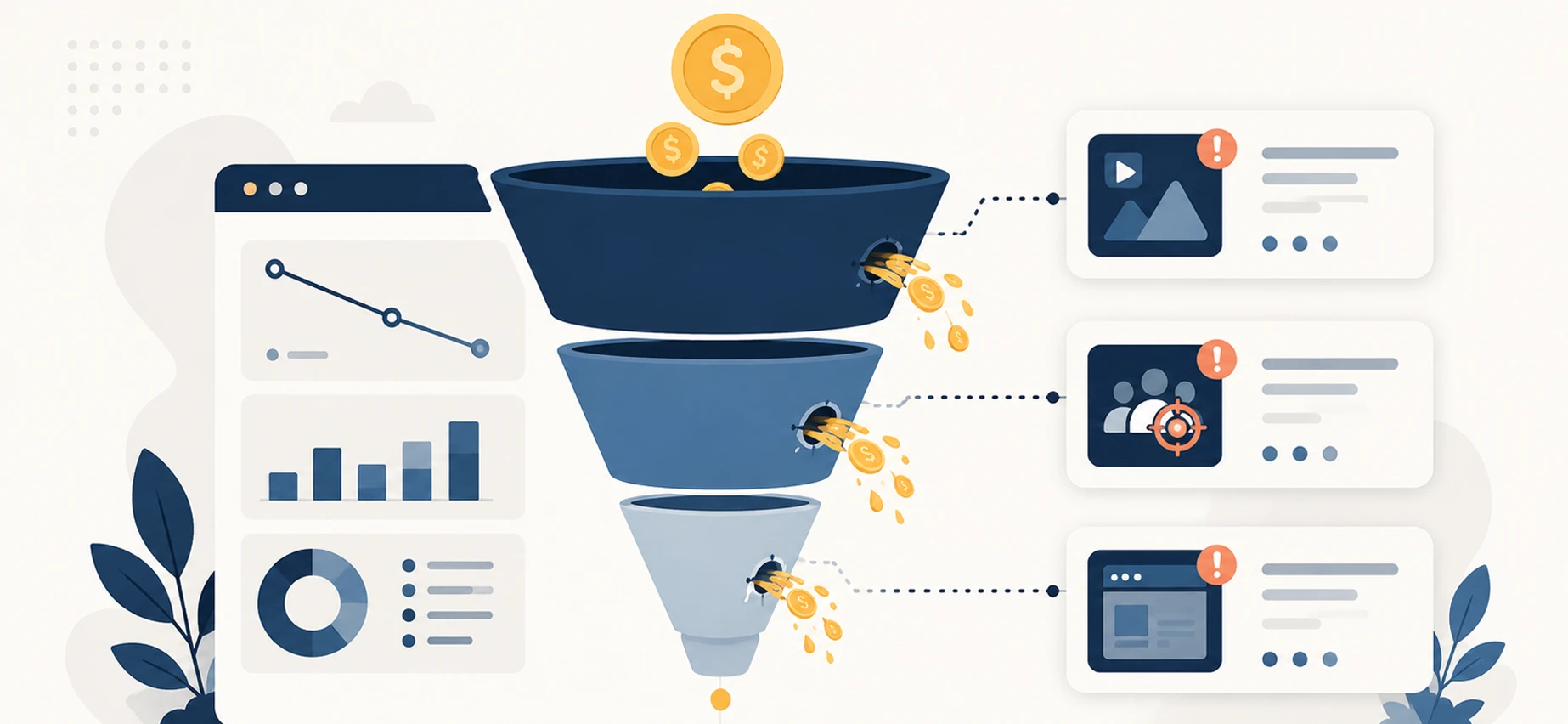
"Meta ads aren't working" is almost never one problem. It's three completely different problems that produce the same feeling — money leaving your account with nothing to show for it — and each needs a different fix. Most advice skips straight to "improve your creative" or "fix your targeting" without helping you work out which of the three you actually have.
This guide does that diagnosis first. It covers how to tell whether you have a problem at all, how to identify which of the three failure points you're hitting, and the fixes that matter for each — including two issues that hit Indian small businesses hard and rarely get written about: lead quality and audience exhaustion in smaller cities.
First: Do You Actually Have a Problem?
A surprising number of "my ads aren't converting" cases turn out to be normal performance judged too early or against the wrong benchmark. Before changing anything, check your numbers against what's typical in the Indian market:
| Metric | Typical range (India) | What it means if you're below |
|---|---|---|
| Outbound CTR | 1–3% | Creative or offer problem — people aren't interested enough to click |
| Landing page conversion rate | 1–3% (3%+ is strong) | Page, offer, or ad-to-page mismatch problem |
| Cost per lead | ₹80–₹350 for most local services | Compare against what a lead is worth to you, not a global benchmark |
| Frequency | Under 3 in a 7-day window | Above this, ad fatigue is likely dragging results down |
The other half of this question is volume. If your ad set has delivered 400 impressions and 12 clicks, zero conversions tells you nothing — that's ordinary variation, not evidence. Give an ad set at least seven days and roughly 50 link clicks before you draw conclusions, and resist editing it in the meantime. Every edit risks resetting the learning phase, which is the most expensive self-inflicted wound in small-budget advertising. We covered why concentration beats tinkering in our guide to running Meta ads on a small budget.
The Three-Symptom Diagnostic
Once you're past the "is this even a problem" question, everything narrows to one of three failure points. Find your symptom in the left column:
| Symptom | The real problem | Where to look |
|---|---|---|
| Low impressions, very few clicks | People aren't clicking | Creative, hook, offer, budget |
| Good clicks, no conversions | People click but don't act | Landing page, form, offer, price |
| You know sales happened, but Ads Manager shows nothing | Conversions aren't being recorded | Pixel, events, attribution window |
Working in this order matters. Rebuilding a landing page won't help if nobody is clicking through to it, and perfecting your creative is wasted effort if the pixel never fires and Meta can't learn who your buyers are.
Problem 1: People Aren't Clicking
If your CTR is sitting below roughly 1%, the issue is upstream of everything else. Meta is showing your ad to people and they're scrolling past it.
The instinct here is to narrow the audience, and it's the wrong move. Since the iOS tracking changes, interest targeting alone is far less precise than it used to be, and Meta's delivery system now does most of the audience-finding work. Your creative is your targeting — the ad itself filters who stops and who keeps scrolling.
What actually moves CTR:
- The first two seconds. On video, if the opening frame doesn't interrupt the scroll, nothing after it gets seen. A face, a problem stated plainly, or an unexpected visual beats a polished brand intro almost every time.
- Clarity over cleverness. If someone can't tell what you're selling and who it's for within a couple of seconds, they won't invest the time to work it out.
- A reason to act now. Not necessarily a discount — a limited batch, a seasonal fit, a bundled add-on, or a genuine deadline all work.
- Real variety in your creative. Five images that say the same thing aren't a test. A UGC-style video, a customer testimonial, a before-and-after, and a plain graphic with a direct offer are four genuinely different bets.
One budget caveat worth knowing: if your CPM is high and your daily budget is small, you may simply be buying too few impressions to generate meaningful clicks. That's an arithmetic problem, not a creative one.
Problem 2: People Click but Don't Convert
This is the most common and most frustrating case — traffic is arriving, and none of it turns into anything.
The ad and the page don't match
Someone clicks an ad for a specific product or offer and lands on your homepage, or on a page where they have to hunt for what they just saw. That gap between promise and page is where most conversions are lost. The landing page should feel like a continuation of the ad — same product, same offer, same wording, visible without scrolling.
The page itself is the problem
Load time, mobile layout, and form length quietly destroy more campaigns than targeting ever has. Almost all Meta traffic in India arrives on a phone, often on a patchy connection. A page that takes four seconds to load has already lost a share of that traffic before anyone reads a word. Our post on 10 signs your website is costing you customers is a useful audit here — paid traffic doesn't fix a weak page, it just makes the leak more expensive.
The offer isn't competitive
Sometimes nothing is technically broken. If a competitor offers faster delivery, clearer pricing, or a better guarantee, your ads will underperform no matter how well the account is built. Paid media amplifies an offer — it doesn't rescue one.
The wrong performance goal
Meta's algorithm is literal. It optimises for exactly the event you name, and nothing beyond it. If you select traffic or engagement while hoping for purchases, you'll get precisely what you asked for: cheap clicks from people with no intent to buy. If you want sales, the conversion event must be the sale.
Problem 3: Conversions Are Happening but Not Being Recorded
This one is deceptive, because everything looks broken when the account is actually fine. You know orders came in this week; Ads Manager reports two conversions.
It matters for more than reporting. Meta uses conversion data to learn who your buyers are. If those events never arrive, the system assumes the ads aren't working and delivers accordingly — so a tracking problem quietly becomes a performance problem.
- Confirm the pixel fires on every page, not just the homepage, and that it survived your last website or theme update. A checkout change breaking the pixel is one of the most common causes of a campaign that "suddenly stopped working".
- Use standard events for the action that matters — purchase, lead, or booking — rather than a custom event where a standard one exists.
- Set up the Conversions API. Browser-based tracking alone now misses a meaningful share of conversions, and server-side data fills that gap.
- Check your attribution window before concluding anything. If it's set to 1-day click and your customers typically take a few days to decide, a large share of genuine conversions simply won't be credited to the ad that produced them.
The India Problem Nobody Writes About: Lead Quality
There's a fourth failure mode that doesn't appear in most guides, and it's the one Indian small businesses hit most often: the leads arrive, the cost per lead looks excellent, and almost none of them answer the phone.
Instant forms are the usual culprit. They pre-fill a user's name and number, which makes submitting almost frictionless — and frictionless submission attracts people with no real intent. A campaign producing ₹40 leads that never convert is worse than one producing ₹200 leads that do, but the dashboard makes the first look like a win.
Three fixes, in order of impact:
- Switch the instant form to the higher-intent setting, which adds a review step before submission. Volume drops, contact rate usually rises sharply.
- Add one qualifying question — budget range, city, or timeline. It filters casual submissions and gives your sales team context before the first call.
- Respond within minutes, not hours. Someone who filled a form while scrolling Instagram at 10pm has forgotten your business by the next morning. A WhatsApp message within the first few minutes, while the ad is still fresh in their mind, consistently outperforms a call the following day.
That last point is the one most businesses underestimate. In India, the conversion often doesn't happen on the website at all — it happens in a WhatsApp conversation afterwards. If that handoff is slow or nobody owns it, the ad account gets blamed for a follow-up failure.
The Tier-2 City Problem: You've Run Out of Audience
If you're advertising to a single city like Bhavnagar, Rajkot, or Jamnagar rather than the whole country, your addressable audience is finite in a way that national advertisers never experience. Ads that performed well for six weeks can decline sharply, not because anything broke, but because most of the relevant people have now seen them several times.
Frequency is the number to watch. Once the average person has seen an ad more than three or four times in a short window, response rates typically fall while costs rise. In a small-city audience, that threshold arrives far faster than the benchmarks assume.
Practical responses: refresh creative on a shorter cycle than a national advertiser would, widen the radius to include nearby towns and districts, or shift a portion of budget to retargeting people who already engaged rather than continuing to pay to reach the same cold audience.
What Not to Do While You're Diagnosing
- Don't change five things at once. You'll fix the problem and never know which change did it — which means you can't repeat it.
- Don't rebuild the campaign from scratch. Duplicating into a fresh campaign restarts learning and discards the data you've already paid for.
- Don't narrow targeting as a first response. It's the most common reaction and, in the current system, usually makes delivery worse.
- Don't raise the budget to escape poor performance. Scaling a campaign that isn't converting only increases the rate of loss.
- Don't blame the algorithm. It isn't a diagnosis, and it rules out every fix that's actually available to you.
The question isn't "why aren't my ads working" — it's "at which step is this breaking." Clicks, conversions, and tracking fail for entirely different reasons, and the fix for one will do nothing for the other two.
Ads running but nothing converting?
Buzzlane audits Meta ad accounts to find exactly where the funnel is breaking — creative, landing page, tracking, or follow-up — before you spend another rupee.
Frequently Asked Questions
How long should I run a Meta ad before deciding it isn't converting?
At least 7 days, and ideally until the ad set has delivered somewhere around 1,000 impressions and 50 or more link clicks. Below that volume, a run of zero conversions is normal statistical variation rather than proof of a broken campaign, and pausing early resets the learning phase for no reason.
Why am I getting leads from Meta ads but they never answer the phone?
This is usually a lead quality problem rather than a delivery problem. Instant forms that pre-fill a user's details make it very easy to submit without real intent. Adding a qualifying question, switching the form to higher intent, and calling or messaging within the first few minutes typically improves contact rates far more than changing your targeting.
Should I fix my targeting or my creative first when Meta ads aren't converting?
Creative, in almost every case. Meta's delivery system now handles most of the audience-finding work, so the creative is what filters who stops scrolling and who clicks. Reworking targeting is the most common first move and usually the least effective one.
Can a small audience in a tier-2 city cause Meta ads to stop converting?
Yes. In a single-city audience, the same people see your ads repeatedly and frequency climbs quickly. Once frequency passes roughly 3 to 4 in a short window, performance usually declines. Widening the radius, rotating creative more often, or extending to nearby districts generally restores results.
My ads worked for months and suddenly stopped converting. What changed?
The three most common causes are creative fatigue after prolonged delivery to the same audience, a website or checkout change that quietly broke the pixel, and a seasonal rise in auction competition. Checking whether conversions are still being recorded in Events Manager is the fastest way to rule out the tracking cause first.
Latest Posts


Relevant Post


Satish M
With 15 years in IT and a passion for pixels, Satish is the brain behind Buzzlane. As a Web Designer and Front-End Developer turned founder, he knows what makes the web work — and more importantly, what makes it wow.